backen = to bake

backt · backte · hat gebacken

regular · irregular participle · haben

Backen: Ein Verb für Leckerbissen

Das Verb “backen” ist ein vielseitiges Wort, das für viele verschiedene Aktivitäten verwendet werden kann. Im Allgemeinen bedeutet es, etwas in einem Ofen oder in Fett zu garen. Aber es kann auch bedeuten, etwas mit Mehl, Zucker und anderen Zutaten zu vermengen und dann zu braten oder zu schmoren.

Beispiele: backen

  • Ich backe heute einen Kuchen.
  • Meine Mutter backt immer leckere Kekse.
  • Der Bäcker backt Brot und Brötchen.
  • Ich habe in der Schule gelernt, wie man Brot backt.
  • Oma backt gerne Apfelkuchen.
  • Wir backen am Wochenende Pizza.
  • Ich backe einen Kuchen. (Ich backe einen Kuchen.)
  • Sie backt Brot. (Sie backt Brot.)
  • Er backt Pizza. (Er backt Pizza.)

backen: Present (Tense)

Die Mutter backt für die Kinder Brot.
The mother bakes bread for the children.

Wir backen jeden Morgen frisch.
We bake fresh every morning.

Backt ihr Bauernbrot in eurem Holzofen?
Do you bake farm bread in your wood-burning oven?

Backt die Bäckerei Brot in ihren Holzöfen?
Does the bakery bake bread in their wood-burning ovens?

Backt ihr einen Kuchen?
Are you baking a cake?

Conjugation: Present - backen (to bake)
German (singular)English (singular)
Ich backe.I bake.
Du bäckst.
Sie backen.
You bake. (informal)
You bake. (formal)
Er bäckt.
Sie bäckt.
Es bäckt.
He bakes.
She bakes.
It bakes.
German (plural)English (plural)
Wir backen.We bake.
Ihr backt.You (all) bake.
Sie backen.
Sie backen.
You bake. (formal)
They bake.

BACKEN: Imperfect (Tense)

Sie buk vier Kuchen.
She baked four cakes.

Ich buk einen Apfelkuchen.
I baked an apple pie.

Gestern backte ich einen Kuchen.
I baked a cake yesterday.

Er buk Muffins.
He baked muffins.

Hannah backt so gern, dass sie jeden Tag einen Kuchen backte.
Hannah loved baking so much that she baked a cake every day.

Sven buk drei Kuchen.
Sven baked three cakes.

Sie buk einen Kuchen.
She baked a cake.

Sven buk herzförmige Kekse.
Sven buk heart-shaped cookies.

Mike buk Hannah einen Kuchen.
Mike baked Hannah a cake.

Conjugation: Imperfect - backen (to bake)
German (singular)English (singular)
Ich buk.I baked.
Du bukst.You baked. (informal)
Er buk.
Sie buk.
Es buk.
He baked.
She baked.
It baked.
German (plural)English (plural)
Wir buken.We baked.
Ihr bukt.You (all) baked.
Sie buken.
Sie buken.
You baked. (formal)
They baked.

BACKEN: Perfect (Tense)

Ich habe gestern einen Kuchen gebacken.
I baked a cake yesterday.

Hast du schon einen Kaffeekuchen gebacken?
Have you baked a coffee cake yet?

Adele hat für morgen einen Hochzeitskuchen gebacken.
Adele baked a wedding cake for tomorrow.

Sie hat ihrem Mann einen Apfelkuchen gebacken.
She baked an apple pie for her husband.

Dieses Jahr habe ich eine Menge Kekse aus Vanilleteig gebacken.
This year I baked a lot of vanilla dough cookies.

Conjugation: Perfect - backen (to bake)
German (singular)English (singular)
Ich habe gebacken.I have baked.
Du hast gebacken.You have baked. (informal)
Er hat gebacken.
Sie hat gebacken.
Es hat gebacken.
He has baked.
She has baked.
It has baked.
German (plural)English (plural)
Wir haben gebacken.We have baked.
Ihr habt gebacken.You (all) have baked
Sie haben gebacken.
Sie haben gebacken.
You have baked. (formal)
They have baked.

BACKEN: Future (Tense)

Hannah wird morgen einen Kuchen backen.
Hannah will bake a cake tomorrow.

Wann wirst du mir einen Schokoladenkuchen backen?
When are you going to bake me a chocolate cake?

In der Kochschule werden wir irgendwann einen Kuchen backen.
In culinary school we will eventually bake a cake.

Conjugation: Future - backen (to bake)
German (singular)English (singular)
Ich werde backen.I will bake.
Du wirst backen.You will bake. (informal)
Er wird backen.
Sie wird backen.
Es wird backen.
He will bake.
She will bake.
It will bake.
German (plural)English (plural)
Wir werden backen.We will bake.
Ihr werdet backen.You (all) will bake.
Sie werden backen.
Sie werden backen
You will bake. (formal)
They will bake.

BACKEN: Imperative (Tense)

PersonSingulärPlural
duBacke!Backt!
SieBacken Sie!Backen Sie!

Leute, backt und fühlt euch Zwergenstark.
People, bake and feel dwarf strong.

Backe! Backt! Backen Sie!
Bake! Bakes! Bake!

“Backen Sie immer ein Probeplätzchen.” – Backen für Dummies
Always bake a sample cookie.

“Backen Sie Rezepte nach, in denen bekannte Zutaten verwendet und vertraute Techniken angewendet werden.” – Backen für Dummies
Bake recipes using familiar ingredients and familiar techniques.

“Backen Sie Ihre Minis bei 180 Grad.” – Backen für Dummies
Bake your minis at 180 degrees.


BACKEN: Imperative (Tense)

Backen Sie für ca. 2 Stunden 15 Minuten.
Bake for about 2 hours 15 minutes.

Backen Sie bis die Kekse fest sind.
Bake until the cookies are firm.

Backen Sie bei 350F Grad für über 30 Minuten bis der Käse knusprig ist.
Bake at 350F degrees for over 30 minutes until the cheese is crisp.


BACKEN: Infinitive (Tense)

Ich habe nicht mehr die Zeit zu backen.
I don’t have time to bake anymore.

Niemand brachte mir bei zu backen.
Nobody taught me how to bake.

Mein Ziel ist einen Apfelkuchen zu backen.
My goal is to bake an apple pie.

Also hast du noch genug Zeit ihm einen Kuchen zu backen.
So you still have enough time to bake a cake for him.

“Sorgfalt und genaues Arbeiten ist hier Grundvoraussetzung, um eine gleichbleibende Qualität zu backen.” – Brot Back Buch von LUTZ GEIßLER


backen - to bake: DaF Books vocabulary list
backen – to bake: DaF Books level 1a vocabulary list

Übungen:

  1. Was backst du heute?
  2. Wer backt bei dir zu Hause am häufigsten?
  3. Was ist dein Lieblingskuchen?
  4. Magst du lieber Kuchen oder Kekse?
  5. Kennst du ein Rezept für einen guten Apfelkuchen?

Level 1.1 [1a]

fahren = to drive, to go (by vehicle)

fährt · fuhr · ist gefahren

irregular · sein


Conjugation of Fahren: Examples of Present (Tense)

Bald fahren wir nach Nürnberg.
We will soon be going to Nuremberg.

Wir fahren nur durch Frankreich.
We only drive through France.

Emma fährt heute oder morgen los.
Emma leaves today or tomorrow.

Wir fahren und fahren durch das hügelige Gelände dieses unbekannten Landes.
We drive and drive through the hilly terrain of this unknown country.
Conjugation: Present - fahren (to drive)
POVGerman (singular)English (singular)
1sg.Ich fahre.I drive.
2sg.Du fährst. (informal)
Sie fahren. (formal)
You drive.
You drive.
3sg.Er fährt.
Sie fährt.
Es fährt.
He drives.
She drives.
It drives.
POVGerman (plural)English (plural)
1pl.Wir fahren.We drive.
2pl.Ihr fahrt. (informal)
Sie fahren. (formal)
You (all) drive.
You (all) drive.
3pl.Sie fahren.They drive.

Conjugation of Fahren: Examples of Imperfect (Tense)

Ja, ich fuhr nach Houston.
True. I drove to Houston.

Ich fuhr zu einer anderen Freundin.
I drove to another friend.

Die glauben nicht, dass ich fuhr.
They don't think I was driving.

Er fuhr auch sein erstes Rennen.
He also drove his first race.

Ich fuhr mit dem Bus zurück.
I took the bus back.
Conjugation: Imperfect - fahren (to drive)
German (singular)English (singular)
Ich fuhr.I drove.
Du fuhrst.You drove. (informal)
Er fuhr.
Sie fuhr.
Es fuhr.
He drove.
She drove.
It drove.
German (plural)English (plural)
Wir fuhren.We drove.
Ihr fuhrt.You (all) drove.
Sie fuhren.
Sie fuhren.
You drove. (formal)
They drove.

Conjugation of Fahren: Examples of Perfect (Tense)

Es war dunkel, ich bin gefahren.
It was dark, I was driving.

Du bist gefahren, als Glenn 7 Jahre alt war?
You drove when Glenn was 7 years old?

Wir sind gefahren, oder?
We drove, didn't we?
Conjugation: Perfect - fahren (to drive)
German (singular)English (singular)
Ich bin gefahren.I have driven.
Du bist gefahren.You have driven. (informal)
Er ist gefahren.
Sie ist gefahren.
Es ist gefahren.
He has driven.
She has driven.
It has driven.
German (plural)English (plural)
Wir sind gefahren.We have driven.
Ihr seid gefahren.You (all) have driven.
Sie sind gefahren.
Sie sind gefahren.
You have driven. (formal)
They have driven.

Conjugation of Fahren: Examples of Future (Tense)

Machen Sie eine Reise von ihm, ich werde fahren.
Take a trip from him, I'll drive.

Ich werde fahren, ich weiß, dass ich fahren kann.
I will drive, I know that I can drive.

Mahmut wird fahren, aber es gehört dir.
Mahmut will drive, but it's yours.

Mein Mann wird fahren!
My husband will drive!

Die Mutter wird fahren, ich halte meine Waffe auf die Kleine gerichtet.
The mother will drive, I keep my gun pointed at the little one.

Keine Sorge, ja, du wirst fahren.
Don't worry, yes, you will drive.
Conjugation: Future - fahren (to drive)
German (singular)English (singular)
Ich werde fahren.I will drive.
Du wirst fahren.You will drive. (informal)
Er wird fahren.
Sie wird fahren.
Es wird fahren.
He will drive.
She will drive.
It will drive.
German (plural)English (plural)
wir werden fahren.We will drive.
Ihr werdet fahren.You (all) will drive.
Sie werden fahren.
Sie werden fahren.
You will drive. (formal)
They will drive.

Conjugation of Fahren: Examples of Imperative (Tense)

Fahrer, fahren Sie an den Straßenrand.
Driver, drive to the side of the road.

OK, Jungs, fahren wir.
OK, guys, let's go.

Wenn du fahren willst, dann fahre.
If you want to drive, then drive.

Fahren, fahren und nochmals fahren?
Driving, driving and driving again?

Fahr mich einfach ins Hotel.
Just drive me to the hotel.

Fahren Sie doch nächstes Jahr hier mit.
Go here next year.

Conjugation of Fahren: Examples of Infinitive (Tense)

Von hier gehen auch die Bootstouren los, die um die Insel herum fahren.
From here you can also start the boat tours that go around the island.

Es ist ratsam, mit dem Zug zu fahren.
It is advisable to take the train.

Ein Fahrschulkurs ermöglicht es auch ohne Führerschein zu fahren.
A driving school course makes it possible to drive without a license.

Du bist zu betrunken um zu fahren.
You are too drunk to drive.

Er würde mir nicht erlauben, sein Auto zu fahren.
He wouldn't allow me to drive his car.

Level 1.1 [1a]
fahren - to drive: DaF Books vocabulary list
fahren – to drive: DaF Books vocabulary list

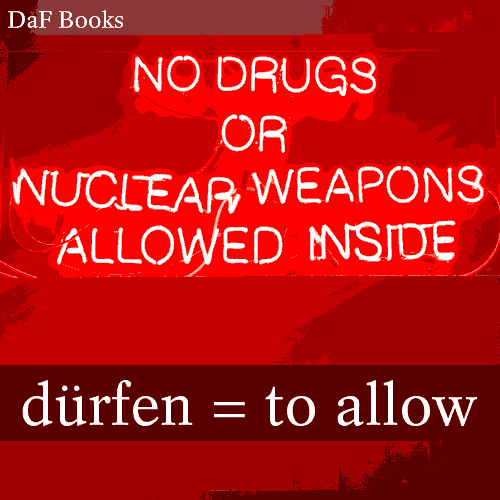
dürfen = to be allowed to, may

darf · durfte · hat gedurft

irregular · haben


Conjugation of Dürfen: Examples of Present

Einige Schüler dürfen bald wieder zum Unterricht.
Some students will soon be allowed to go back to class.

Darf ich mit dir fahren?
Can I drive with you?

Dürfen wir XBox spielen?
Can we play XBox?

Dürfen wir nach Hause gehen?
Can we go home?

Überprüfen Sie, ob Sie eine U.S Green Card erhalten dürfen.
Check whether you are allowed to receive a U.S. Green Card.
Conjugation: Present - dürfen (to allow, be able to)
German (singular)English (singular)
Ich darf.I may.
Du darfst.You may. (informal)
Er darf.
Sie darf.
Es darf.
He may.
She may.
It may.
German (plural)English (plural)
Wir dürfen.We may.
Ihr dürft.You (all) may.
Sie dürfen.
Sie dürfen.
You may. (formal)
They may.

Conjugation of Dürfen: Examples of imperfect

Ich durfte nach Hause gehen.
I was allowed to go home.

Ich durfte nicht mehr hingehen.
I was no longer allowed to go.

Ich durfte noch nicht zu Ende reden.
I wasn't allowed to finish talking yet.
Conjugation: Imperfect - dürfen (to allow, be able to)
German (singular)English (singular)
Ich durfte.I was allowed to.
Du durftest.You were allowed to. (informal)
Er durfte.
Sie durfte.
Es durfte.
He was allowed to.
She was allowed to.
It was allowed to.
German (plural)English (plural)
Wir durften.We were allowed to.
Ihr durftet.You (all) were allowed to.
Sie durften.
Sie durften.
You were allowed to.(formal)
They were allowed to.

Conjugation of Dürfen: Examples of Plusquamperfekt (konjunktiv II)

Sie hätte den ganzen Abend mit euch gespielt, wenn sie gedurft hätte.
She would have played with you all evening if she had been allowed to.

Natürlich, du hättest längst gedurft.
Of course, you should have been long ago.

Vielleicht hätte ich das nicht gedurft.
Maybe I shouldn't have been allowed to.
Conjugation: Plusquamperfekt - dürfen (to allow, be able to)
German (singular)English (singular)
Ich hätte gedurft.I could/should have been allowed to.
Du hättest gedurft.You could/should have been allowed to. (informal)
Er hätte gedurft.
Sie hätte gedurft.
Es hätte gedurft.
He could/should have been allowed to.
She could/should have been allowed to.
It could/should have been allowed to.
German (plural)English (plural)
Wir hätten gedurft.We could/should have been allowed to.
Ihr hättet gedurft.You (all) could/should have been allowed to.
Sie hätten gedurft.
Sie hätten gedurft.
You could/should have been allowed to. (formal)
They could/should have been allowed to.

Conjugation of Dürfen: Examples of Future

Wir werden morgen von Bord gehen dürfen.
We will be allowed to disembark tomorrow.

Wir dürfen und werden nicht zulassen, dass unsere Welt bedroht wird.
We cannot and will not allow our world to be threatened.

Die Aufenthaltstitel sollen nicht regional beschränkt werden dürfen.
The residence permits should not be restricted to regions.
Conjugation: Future - dürfen (to allow, be able to)
German (singular)English (singular)
Ich werde dürfen.I will be allowed to.
Du wirst dürfen.You will be allowed to. (informal)
Er wird dürfen.
Sie wird dürfen.
Es wird dürfen.
He will be allowed to.
She will be allowed to.
It will be allowed to.
German (plural)English (plural)
Wir werden dürfen.We will be allowed to.
Ihr werdet dürfen.You (all) will be allowed to.
Sie werden dürfen.
Sie werden dürfen.
You will be allowed to. (formal)
They will be allowed to.

Conjugation of Dürfen: Examples of Imperative

Hinweis: Der Imperativ existiert nicht für Modalverben.
Note: The imperative does not exist for modal verbs.

DÜRFEN is a modal verb. Modal verbs do not possess an imperative form.

Conjugation of Dürfen: Examples of Infinitive

EXAMPLES:

Wir bitten, darauf zurückkommen zu dürfen.
We ask to come back to this.

Schön, Sie mal wieder begrüßen zu dürfen.
Nice to be able to meet you again.

Ich freue mich sehr, wieder einmal hier oben stehen zu dürfen.
I am very happy to be up here again.

Wir freuen uns, Sie zu unseren Partnern zählen zu dürfen.
We look forward to counting you among our partners.

Dann freue ich mich, Ihnen behilflich sein zu dürfen.
Then I look forward to helping you.

Level 1.1 [1a] Modal Verbs
dürfen - to allow: DaF Books vocabulary list
dürfen – to allow: DaF Books vocabulary list
The images used on this page belong to the copyright holder. For more information, please visit the Level 1.1 Verbs [1a] image credits page.

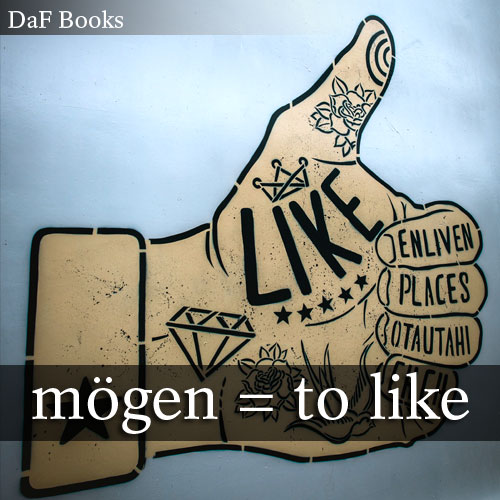
mögen = to like

mag · mochte · hat gemocht

irregular · haben


Conjugation of Mögen: Examples of Present (Tense)

Ich mag chinesischen Rap.

Ich mag Deutsch lieber als Latein.
I like German more than Latin.

Jeder mag Deutsch lieber als Latein, weil Latein eine tote Sprache und einfach scheiss ist.
Everyone likes German more than Latin because Latin is a dead language and just shit.
Conjugation: Present - mögen (to like)
German (singular)English (singular)
Ich mag.I like.
Du magst.You like. (informal)
Er mag.
Sie mag.
Es mag.
.He likes
She likes.
It likes.
German (plural)English (plural)
Wir mögen.We like.
Ihr mögt.You (all) like.
Sie mögen.
Sie mögen.
You like. (formal)
They like.

Conjugation of Mögen: Examples of Imperfect (Tense)

Mike mochte damals kein Bier.
Mike didn't like beer at the time.

Als Kind mochte ich Zeichentrickfilme.
As a child, I liked animated films.

Sven mochte mich anfangs nicht besonders.
Sven didn't particularly like me at first.

Natürlich mochte es keiner von ihnen.
Of course, none of them liked it.
Conjugation: Imperfect - mögen (to like)
German (singular)English (singular)
Ich mochte.I liked.
Du mochtest.You liked. (informal)
Er mochte.
Sie mochte.
Es mochte.
He liked.
She liked.
It liked.
German (plural)English (plural)
Wir mochten.We liked.
Ihr mochtet.You (all) liked.
Sie mochten.
Sie mochten.
You liked. (formal)
They liked.

Conjugation of Mögen: Examples of Perfect (Tense)

Die Arbeit am Bau habe ich nie gemocht.
I never liked working on construction.

Hast du dieses Kartenspiel gemocht?
Did you like this card game?

Hast du das Buch gemocht?
Did you like the book?
Conjugation: Perfect - mögen (to like)
German (singular)English (singular)
Ich habe gemocht.I have liked.
Du hast gemocht.You have liked. (informal)
Eer hat gemocht.
Sie hat gemocht.
Es hat gemocht.
He has liked.
She has liked.
It has liked.
German (plural)English (plural)
Wir haben gemocht.We have liked
Ihr habt gemocht.You (all) have liked.
Sie haben gemocht.
Sie haben gemocht.
You have liked. (formal)
They have liked.

Conjugation of Mögen: Examples of Future (Tense)

Ich werden meine neue Arbeitskollegin mögen. Glaube ich.
I will like my new co-worker. I believe.

Du wirst mich eines Tages mögen.
You will like me some day.

Vielleicht wirst du den Tarantino Film mögen.
Maybe you will like the Tarantino film.

Die Kinder werden dieses schwieriges Lernspiel nicht mögen.
The kids won't like this difficult, educational game.

Vielleicht wird Mike das neue Stephen King Buch mögen.
Maybe Mike will like the new Stephen King book.
Conjugation: Future - mögen (to like)
German (singular)English (singular)
Ich werde mögen.I will like.
Du wirst mögen.You will like. (informal)
Er wird mögen.
Sie wird mögen.
Es wird mögen.
He will like.
She will like.
It will like.
German (plural)English (plural)
Wir werden mögen.We will like.
Ihr werdet mögen.You (all) will like.
Sie werden mögen.
Sie werden mögen.
You will like. (formal)
They will like.

Conjugation of Mögen: Examples of Imperative (Tense)

Hinweis: Der Imperativ existiert nicht für Modalverben.
Note: The imperative does not exist for modal verbs.

MÖGEN is a modal verb. Modal verbs do not possess an imperative form.

Conjugation of Mögen: Examples of Infinitive (Tense)

EXAMPLES:

Alle anderen schienen Mike zu mögen.
Everyone else seemed to like Mike.

Jack scheint dich richtig zu mögen, Hannah.
Jack seems to really like you, Hannah.

Die Kinder scheinen dich irgendwie zu mögen.
The kids seem to like you somehow.

Herr Gregor scheint euch wirklich zu mögen.
Mr. Gregor really seems to like you.

Es ist ziemlich entscheidend, Äpfel zu mögen.
It es really crucial to like apples.

Die Familie scheint Sven zu mögen.
The family seems to like Sven.

Es steht der Rechten frei, die deutsche Regierung nicht zu mögen.
The right is free not to like the German government.

Deine Frau scheint nicht einmal ihre eigenen Kinder zu mögen.
Your wife doesn't even seem to like her own children.

Du scheinst Spargel wirklich nicht zu mögen.
You really don't seem to like asparagus.

Emma scheint dich nicht besonders zu mögen, Sven.
Emma doesn't seem to like you very much, Sven.

Level 1.1 [1a] Modals
mögen - to like: DaF Books vocabulary list
mögen – to like: DaF Books vocabulary list

bleiben = to stay

Deutsch als Fremdsprache

bleibt · blieb · ist geblieben

irregular · sein

During the (COVID-19) Coronavirus pandemic, it is extremely important to stay at home. If everyone follows this simple rule (and stays at home), 2020 will be the year that the entire population of planet Earth worked together to solve a very difficult problem. Bitte, Bleiben Sie zuHause!

#wirbleibenzuhause


Conjugation of Bleiben: Examples of Present

Wenn die Schachtel dauernd offen bleibt, verderben die Lebensmittel.
If the box is left open all the time, the food will spoil.

Einige Schüler bleiben noch länger zu Hause.
Some students stay at home longer.

Ich bleibe im Haus, weil es draußen regnet.
I stay in the house because it is raining outside.

Er bleibt immer sehr ruhig.
He always stays very calm.

Sie bleibt im Krankenhaus unter Beobachtung.
She remains under observation at the hospital.
Conjugation: Present - bleiben (to stay, remain)
POVGerman (singular)English (singular)
1sg.Ich bleibe.I stay.
2sg.Du bleibst. (informal)
Sie bleiben. (formal)
You stay.
You stay.
3sg.Er bleibt.
Sie bleibt.
Es bleibt.
He stays.
She stays.
It stays.
POVGerman (plural)English (plural)
1pl.Wir bleiben.We stay.
2pl.Ihr bleibt. (informal)
Sie bleiben. (formal)
You (all) stay.
You (all) stay.
3pl.Sie bleiben.They stay.

Conjugation of Bleiben: Examples of Imperfect

Ich blieb zu spät draußen.
I stayed out too late.

Es war gut, dass du bliebst.
It was good that you stayed.

Sie blieben länger als erwartet, Herr Gregor.
You stayed longer than expected, Mr. Gregor.

Er blieb im Hotel.
He stayed in the hotel.
Conjugation: Imperfect - bleiben (to stay, remain)
German (singular)English (singular)
Ich blieb.I stayed.
Du bliebst.You stayed. (informal)
Er blieb.
Sie blieb.
Es blieb.
He stayed.
She stayed.
It stayed.
German (plural)English (plural)
Wir blieben.We stayed.
Ihr bliebt.You (all) stayed.
Sie blieben.
Sie blieben.
You stayed. (formal)
They stayed.

Conjugation of Bleiben: Examples of Perfect

Wir sind stecken geblieben.
We got stuck.

Wir sind zuhause geblieben.
We stayed at home.

Wärst du doch in Düsseldorf geblieben?
Would you have stayed in Düsseldorf?

Wo ist nur mein Schatz geblieben?
Where's my darling gone?
Conjugation: Perfect - bleiben (to stay, remain)
German (singular)English (singular)
Ich bin geblieben.I have stayed.
Du bist geblieben.You have stayed. (informal)
Er ist geblieben.
Sie ist geblieben.
Es ist geblieben.
He has stayed.
She has stayed.
It has stayed.
German (plural)English (plural)
Wir sind geblieben.We have stayed.
Ihr seid geblieben.You (all) have stayed.
Sie sind geblieben.
Sie sind geblieben.
You have stayed. (formal)
They have stayed.

Conjugation of Bleiben: Examples of Future

Ich werde noch eine Woche in Prag bleiben.
I will stay a week longer in Prague.

Sie wird unter dem Mond bleiben. (Lied von Adam Barnes)
She will stay beneath the moon. (Song by Adam Barnes)

Wir werden für immer zusammen bleiben.
We will stay together forever.
Conjugation: Future - bleiben (to stay, remain)
German (singular)English (singular)
Ich werde bleiben.I will stay.
Du wirst bleiben.You will stay. (informal)
Er wird bleiben.
Sie wird bleiben.
Es wird bleiben.
He will stay.
she will stay.
It will stay.
German (plural)English (plural)
Wir werden bleiben.We will stay.
Ihr werdet bleiben.You (all) will stay.
Sie werden bleiben.
Sie werden bleiben.
You will stay. (formal)
They will stay.

Conjugation of Bleiben: Examples of Imperative

Bitte, Bleiben Sie zuHause!
Please, stay home!

Bleiben Sie jung! Bleiben Sie behütet!
Stay young! Stay protected!

Bleiben Sie jung! Bleiben Sie unvergessen!
Stay young! Be unforgettable!

Bleib jung mit yoga!
Stay young with yoga!

"Bleib jung, bezahle nie." Wo hatte Isa den Satz gehört, gelesen?
"Stay young, never pay." Where had Isa heard the sentence, read it?
- "Wir zählen unsere Tage nicht" by Silvio Blatter

Conjugation of Bleiben: Examples of Infinitive

Wir versuchten, in Kontakt zu bleiben.
We tried to stay in touch.

Ich habe genug Gründe zu bleiben.
I have enough reasons to stay.

Pflichtgemäß bitte ich Sie zu bleiben.
I ask you to stay.

Klicken Sie auf Laden, um angemeldet zu bleiben.
Click Load to stay logged in.

Level 1.1 [1a]
bleiben – to stay: DaF Books vocabulary list

Alle Personen und Ereignisse in diesem Werk sind fiktiv. Ähnlichkeiten mit realen, lebenden oder verstorbenen Personen oder tatsächlichen Ereignissen sind rein zufällig.

© 2024 DAF BOOKS